
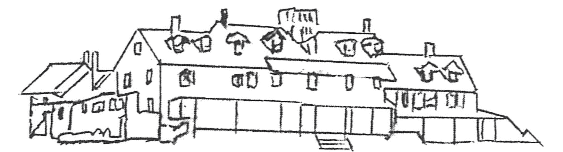

Land Use and Management At The Knob and Harbor House Site: The Carey Family Legacy
The Carey Family Legacy of Preservation and Conservation by Dana Rodin
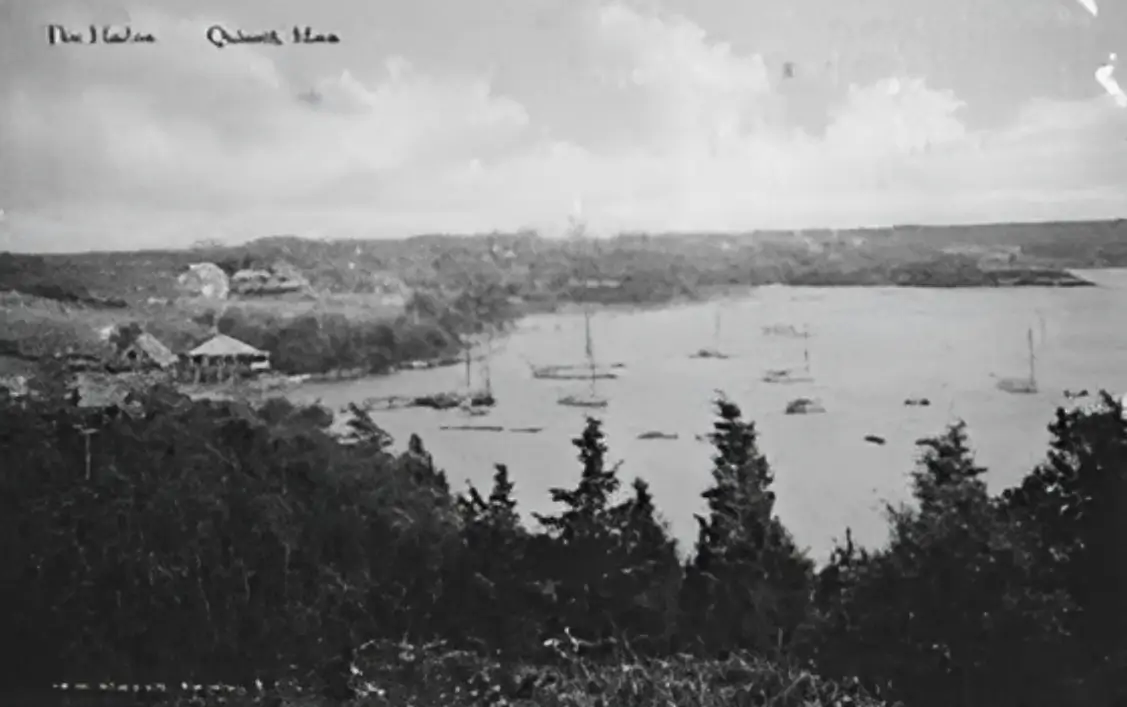
The land between the Knob and The Quissett Harbor House saw relatively few changes from human activities from the time of its formation by glacial activity to the closure of the Hotel. A few arrowheads and shell middens leave us guessing about Indian settlements in the area. Woquamquissett Neck was conveyed to John Weeks in 1704 on the condition of indemnification of the Proprietors from the claims from the heirs of a deceased Indian Weqecoxett with respect to certain rights or "liberty" granted to them for the cutting of firewood. Nineteenth-century photographs showing largely treeless grassland marked by stone walls suggest active grazing by sheep or cows on what was successively named Week's Neck, Hammond's Neck and now,
"the Knob", so named for the elevated headland at the end of the long narrow neck remaining at the very end of the landform. We know from the contents of the deed grants to the relatively few owners and the detail of the 1845 U.S. Coast Survey map of the area that, in addition to farming and grazing activity, the property contained saltworks above the sandbar (roughly identical to others at the north end of the Harbor where Harbor Head Cottage is now) which were dismantled with others on the coast in the 1850's or early 1860's. Timbers from these saltworks and storage sheds found their way into several structures including the large "Summer House" or gazebo that once graced the same location up the hill from the Harbor House Parking lot, the long row of rooms known as "the Alley", and the roof timbers above the side living room of today's remaining Jenkins House. We also know from various accounts and memory back to visible remains in the 1960s that there were fish weirs off the end of the Knob that are referenced and illustrated in the U.S. Fish Commission Report of 1872-'73 that trapped a variety of fish in the early period of use. Our own proprietor of the Harbor House George Washburn Fish, testified in hearings concerning the controversy over the impacts of the weir fishery on the hook and line fishery about the problem of dead scup on the Hotel beach from this activity. Stephen Carey, Jr. also contracted for what was probably the first rock armoring of the Knob in 1918. Though little had changed by human activity and man-made structures by then, the natural forces of wave and wind action were effecting major changes in the erosion of the landform which were sought to be halted or slowed. Thus it was at the death of Miss Carey in 1973 and the last season of the hotel in 1974 that there were challenges ahead from the natural processes already at work and yet to arise from new uses and stewardship for the property.
Carey Family Stewardship
It is reported that Stephen Carey, Jr.'s will referred to his "great fondness for my real estate and that owned by my father at Quissett, which I have known since childhood". His affection for the property was handed down to his daughter Cornelia Carey who bought out her brother Stephen W. Carey, III's interest in the outer 13-acre Knob parcel. Upon Miss Carey's death in September 1973 the property was left to the Massachusetts Audubon Society or alternatively to Salt Pond Areas Bird Sanctuaries in the event, as it did, Audubon declined it. She specifically provided that she did not "wish to have the Town of Falmouth own and manage it." At the time of her gift she did not provide an accompanying endowment or management plan. She had, however, just completed the repair of the rock armor at the Knob, raising it to the top, at her own expense. She was very concerned about the pace of erosion and again sought to counteract it as had her father, before her.
Though she carefully guarded her Knob property, she also shared it by allowing access for those in the community who had connections with the Hotel and her family properties and others she knew who cared about it. Salt Pond opened the Knob property to the public and held a number of Annual Salt Pond Areas Days on it for which we still have the map guide identifying various points of interest and including the Knob promontory as "Hammond's Neck Tick Point". The opening without a management plan was something of an experiment. Some of the "usual suspects", the Francis's and Willetts, helped to cut access paths past the site of the Old Summer House which intersected the central cart path on which Stephen Carey Jr. had in earlier times reportedly driven his Pierce Arrow motorcar to the top of the Knob. Public parking, nighttime access with beach parties and fires led to security measures continuing to this day to try to manage some aspects of the new access, as did vandalism of the rock armor and damage to the banks and vegetation. An effort to explore closure or more controlled access to the Knob was undertaken in the early 1980s but abandoned, as likely to be unsuccessful.
The Closing Of The Quissett Harbor House And The Transition To New Stewardship
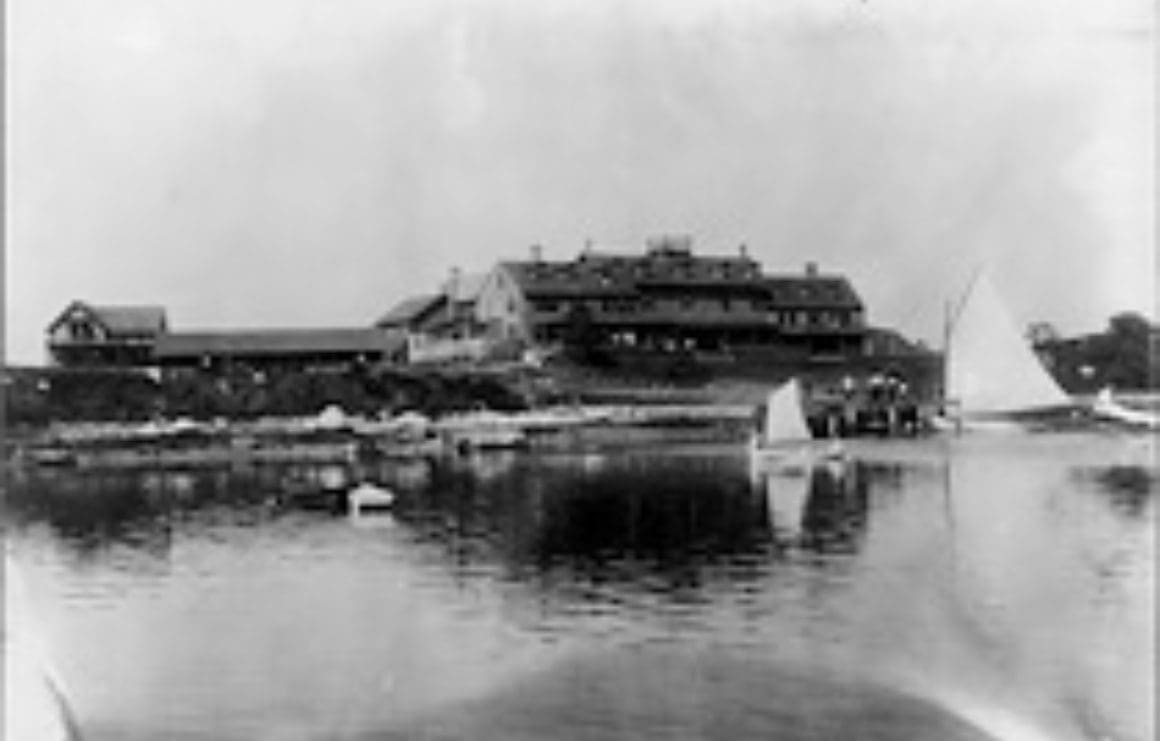
Following Miss Carey's passing, the Hotel operated one more season, Summer 1974, with very few guests. The family made the decision not to re-open the Hotel for the 1975 Summer Season which led to the question of what would become of use of the Beach Club, then better known as the Meat Market, and its platform and bathhouses. Guests and former guests and purchasers of Carey land had swimming privileges there and use of the dinghy dock in the harbor. The Yacht Club at the time held meetings and activity elsewhere (then most recently the Haigh's boathouse adjacent to the Boatyard), although some members used the dinghy dock and the Sailing Class used the outer harbor beach for activities as continues to date. As a result, the Club was sometimes referred to as "the yacht club without a clubhouse".
In late winter and early Spring 1975 a number of Quissett locals who had been accustomed to swimming on the Buzzards Bay side of the property arranged with Helen Carey (Stephen W. Carey III's wife) to take responsibility for the platform and bathhouses, the start of what became known as the Quamquissett Beach Club and a new era of stewardship as other organizations evolved. Sadly, and not for the last time on the site, a fire of unknown and suspicious origin struck the bathhouses, garages, and carriage houses of the facilities. Herb Willett spearheaded the reconstruction of the carriage house into the present Beach Club bathhouse, part of a long tradition of volunteerism at the site continuing to the present. The rebuilding is symbolized in the Beach Club/Land Trust parking sticker with the image of the Phoenix rising from the ashes.
Stephen W. Carey, III, Cornelea's brother and Helen Carey's husband, died in late 1976, and Helen Carey with help and guidance of Lewis W. Francis, Jr., following in the footsteps of his father's efforts at Quissett to keep the Hotel operating in 1916, made important decisions for the future of the site, harbor and community. She had previously refused offers to buy part of the extensive Carey property around the Harbor. Instead, she decided to sell the six-plus central acres around the Hotel buildings to a group large enough to attract and be representative of Quissett's community interests as a whole. The price was made particularly affordable based on a valuation in Cornelia Carey's estate. The Quissett Harbor House Land Trust, Inc. was formed by incorporators Lewis W. Francis, Jr. and Helen M. Carey. Troup Daignault who summered in the historic Eldred homestead across from the Boatyard, wrote an appeal letter in January 1977 and the full purchase price of $60,000 was raised within the month. Most of the property owners around the Harbor joined the Trust, approximately fifty initially which grew rapidly to the one hundred-plus, members/families of today. The Articles of Organization provided for a purpose "to operate a beach and tennis club... and other outdoor recreational activities reasonably consistent with the preservation of the native vegetation and natural beauty of certain land...". While the Trust was formed as a non-profit social and recreational club similar in legal structure to the Yacht Club, the latter did not factor into the initial organization and purposes. Rather, the Yacht Club's uses evolved into the present informal and significantly expanded presence only over time, echoing the informal origins of the Club among the guests of the old Hotel. The Trust from inception provided access to the Knob parcel through its property voluntarily, and contributed financially as well to its public recreation and conservation uses by establishing and maintaining paths in the first instance, and by providing guards for the property and beach. At that time, Salt Pond made financial contributions toward the expense, but care of the Knob was essentially a Quissett-based effort led once again by Lew Francis.
The second major decision made by Helen Carey with Lew Francis' help and guidance was the present unobtrusive subdivision of the roughly twenty-plus acres into the Sunset Hill subdivision of Carey Lane. Lots were sold with an effort to gain the interest of the purchasers in the preservation and conservation interests of the Trust and the traditional and modest use and privileges of the Beach Club. The modest privileges were then as now in large part a "labor of love" in helping to support the property and its historic "anchor" presence on the Harbor. The Carey Lane subdivision, as lots were sold, finally came into being as a much less dense development than the originally proposed cottage lot subdivision of 1872 proposed by Colonel James and Jane Lewis, of which only Petrel's Rest and Harbor Head Cottage remain. One consequence of the Carey Lane subdivision was the zoning requirement that the northernmost Hammond House component of the Harbor House complex (also known as "The Ritz" during the Hotel period) be relocated because of its close proximity to the new subdivision road, Carey Lane.
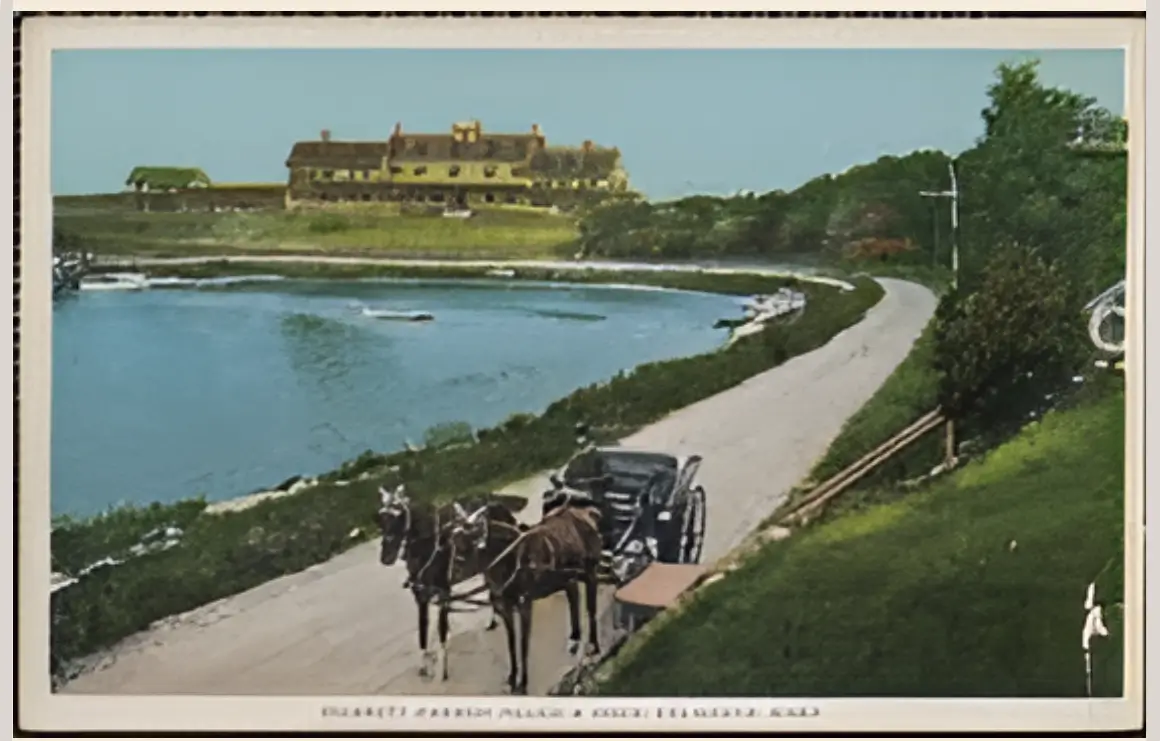
An early decision had also been made to reduce the extent of the buildings on the site by the demolition of the kitchen and bakery structures of the old Hotel together with the Victorian era "Connector". Moll Jones Willett and Virginia Francis worked on furnishing what remained of the Harbor House with a modest budget for furnishings as a summer rental for Land Trust members. An extensive effort was made to find a home for the Hammond House on a Carey Lane lot with a potential buyer or elsewhere locally without success. When this effort did not succeed, Hammond House, circa 1740, was purchased by outside parties and "flaked" for shipment and reconstruction in Bellvue, Washington on the shores of Puget Sound, a long journey for the homestead of Ruth and Isaiah Hammond and Samuel Hammond. It stands there today, reconstructed with a central chimney and clapboard exterior as distinct from its shingle sheathing in Harbor House lemon yellow with Colonial red trim.
Photo Credits: Woods Hole Museum and Baldwin Coolidge